
Table of Contents
Finding the top stock brokers is one of the most important steps for anyone who wants to trade or invest in financial markets. A broker gives traders access to the market. It also provides the platform, tools, pricing, charts, and account features that shape the full trading experience.
However, not all brokers are built the same.
Some brokers are designed for beginners. Some are built for active traders. Some focus on stocks and ETFs. Others provide access to forex, commodities, indices, or more advanced products. Some platforms are simple and mobile-friendly, while others offer deeper tools for technical analysis and order management.
This guide explains how to compare top stock brokers and what traders should look for before choosing a platform.

What Is a Stock Broker?
A stock broker is a company that allows traders and investors to buy and sell financial instruments.
In the past, many trades were placed through phone calls or in-person brokers. Today, most trading happens online through platforms and mobile apps.
Modern brokers may offer access to:
- Stocks
- ETFs
- Options
- Bonds
- Indices
- Forex
- Commodities
- Mutual funds
- CFDs, where permitted
- Other financial products
The exact product list depends on the broker and the region.
Why Broker Choice Matters
Broker choice matters because the platform affects how traders interact with the market.
A strong broker can help traders:
- Access markets more efficiently
- Analyze price movements
- Place orders quickly
- Manage risk
- Track performance
- Stay updated on market news
- Use mobile and desktop tools
A poor broker can make trading harder. It may have confusing fees, slow platforms, weak support, or limited tools.
The goal is to choose a broker that supports your trading style.
What Makes Top Stock Brokers Different?
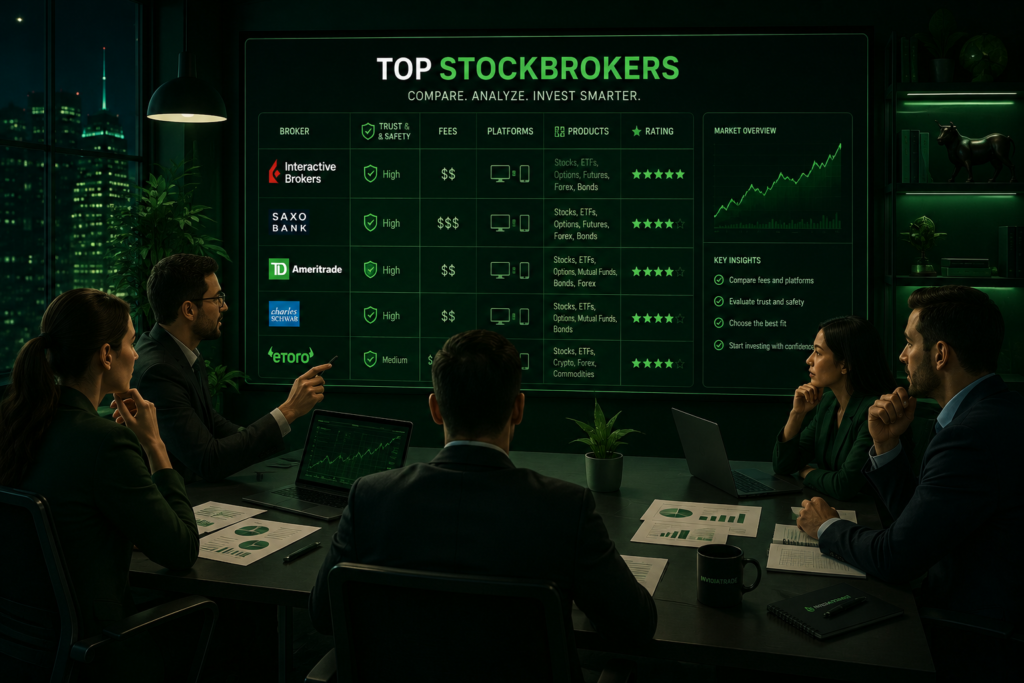
Top stock brokers usually stand out because they combine several important qualities.
These include:
- Transparent pricing
- Reliable platforms
- Strong security
- Useful market access
- Quality charting
- Fast execution
- Helpful education
- Good customer support
- Risk management tools
No broker is perfect. But strong brokers make the trading process clearer and more efficient.
Regulation and Trust
Trust is one of the first things traders should consider.
A broker should operate under clear rules in the markets where it provides services. Traders should verify whether the broker is registered, licensed, or regulated in the relevant region.
This does not remove market risk. It also does not mean a trader cannot lose money. But it can provide more transparency and accountability.
Before opening an account, traders should review:
- Broker registration
- Company background
- Account terms
- Risk disclosures
- Fee schedules
- Withdrawal policies
- Customer reviews
- Platform history
A trustworthy broker should make this information easy to find.
Trading Costs and Fees
Costs matter.
For active traders, fees can add up quickly. For long-term investors, fees can affect returns over time.
Common costs may include:
- Trading commissions
- Spreads
- Account fees
- Platform fees
- Market data fees
- Currency conversion fees
- Withdrawal fees
- Inactivity fees
- Margin interest
Some brokers offer commission-free trading on certain products. That can be attractive. However, traders should still review the full pricing structure.
A low-cost broker is not always the best broker. The real question is whether the broker provides fair value for the tools and service offered.
Market Access
The top stock brokers should give traders access to the markets they actually want to trade.
A trader focused on U.S. stocks may not need the same broker as someone trading global markets. A trader focused on ETFs may not need options or forex. An active trader may want several asset classes in one place.
Market access can include:
- Domestic stocks
- International stocks
- ETFs
- Options
- Forex
- Commodities
- Indices
- Fractional shares
- Extended-hours trading
Before choosing a broker, traders should confirm that the platform supports their preferred markets.
Platform Experience
A trading platform should be easy to use.
This is true for beginners and experienced traders. A confusing platform can slow down decisions and increase mistakes.
A strong platform should include:
- Clean navigation
- Clear account overview
- Fast order entry
- Watchlists
- Easy chart access
- Position tracking
- Custom alerts
- Simple deposit and withdrawal menus
The best platforms feel organized. Traders should be able to find what they need quickly.
Mobile Trading App Quality
Mobile trading is now a major part of the brokerage experience.
Many traders want to monitor positions, receive alerts, and place orders from their phones.
A good mobile app should offer:
- Real-time price updates
- Clear charts
- Easy order placement
- Account overview
- Secure login
- Watchlists
- Notifications
- Simple navigation
Mobile trading is convenient. However, traders should still be careful when placing trades on smaller screens. It is easier to make mistakes when moving quickly.
Desktop Trading Tools
Desktop platforms remain important.
A desktop setup gives traders more screen space and more control. This can be useful for charting, research, and monitoring multiple markets.
Desktop tools may include:
- Advanced charts
- Multiple watchlists
- Market scanners
- News feeds
- Order panels
- Portfolio analytics
- Technical indicators
- Custom layouts
Active traders often prefer desktop platforms for planning and analysis. Mobile apps are useful for monitoring and quick actions.
Charting Features
Charts help traders understand market behavior.
Top stock brokers usually provide charting tools that make analysis easier.
Helpful charting features include:
- Candlestick charts
- Line charts
- Multiple timeframes
- Volume data
- Moving averages
- Trend lines
- Support and resistance tools
- Drawing tools
- Technical indicators
Charting should be clear and responsive. Slow or cluttered charts can make analysis harder.
Research and News
Research tools can help traders make more informed decisions.
Top stock brokers may provide:
- Market news
- Company profiles
- Earnings calendars
- Analyst data
- Fundamental metrics
- Economic calendars
- Sector analysis
- Stock screeners
These tools help traders understand what is happening in the market.
For long-term investors, research helps with company selection. For active traders, research can help explain short-term price movement.
Order Types
Order types give traders more control.
A basic platform may only offer simple buy and sell orders. More advanced brokers may provide several order options.
Common order types include:
- Market orders
- Limit orders
- Stop orders
- Stop-loss orders
- Take-profit orders
- Trailing stops
- Conditional orders
Order types can help traders plan entries and exits. They can also support better risk management.
Execution Quality
Execution quality is important, especially for active traders.
A broker should process orders efficiently and provide clear trade confirmations.
Traders should consider:
- Order speed
- Fill quality
- Platform stability
- Price transparency
- Slippage information
- Trade confirmation details
Execution does not guarantee profit. But poor execution can affect the trading experience.
Risk Management Tools
Risk management should be central to every trading plan.
Top stock brokers often provide tools that help traders manage exposure.
These may include:
- Stop-loss orders
- Take-profit orders
- Price alerts
- Margin alerts
- Portfolio exposure views
- Account history
- Performance reports
These tools help traders stay aware of their account activity.
Risk management is not optional. It is one of the core parts of trading.
Education and Learning Resources
Education is very important, especially for newer traders.
A strong broker often provides learning resources that explain the market and the platform.
Educational features may include:
- Platform tutorials
- Beginner guides
- Market lessons
- Risk management articles
- Webinars
- Video training
- Glossaries
- Strategy explainers
Education helps traders understand what they are doing before they risk capital.
Demo Accounts
Demo accounts can help traders test a platform.
They allow users to practice without using real money. This can be useful before opening a live account.
A demo account helps traders learn:
- How to use the platform
- How order types work
- How charts update
- How positions are displayed
- How alerts are created
- How fast the app feels
Demo trading is not the same as live trading. Real money creates emotion. Still, demo accounts can be helpful for platform practice.
Customer Support
Customer support can make a major difference.
When account issues happen, traders need clear answers.
Good support may include:
- Live chat
- Email support
- Phone support
- Help center articles
- Fast response times
- Clear account guidance
Traders should review support options before funding an account.
Support is especially important for beginners who may need help understanding platform features.
Account Funding and Withdrawals
A broker should make deposits and withdrawals clear.
Before opening an account, traders should understand:
- Deposit methods
- Withdrawal methods
- Processing times
- Possible fees
- Currency options
- Minimum deposit rules
- Verification requirements
A broker should clearly explain how money moves in and out of an account.
Security Features
Security is essential.
A broker handles sensitive personal and financial information. Traders should expect strong account protection.
Security features may include:
- Two-factor authentication
- Secure login systems
- Data encryption
- Withdrawal verification
- Device management
- Account alerts
- Identity verification
Traders should also use strong passwords and avoid sharing login details.
Top Stock Brokers for Beginners
Beginners usually need simplicity and education.
A beginner-friendly broker should offer:
- Easy platform navigation
- Clear pricing
- Educational content
- Demo account access
- Basic research tools
- Helpful support
- Simple mobile app
- Risk warnings
Beginners should avoid platforms that feel too complex at first. It is better to learn gradually.
Top Stock Brokers for Active Traders
Active traders usually need speed and depth.
They may look for:
- Fast execution
- Advanced charting
- Low active trading costs
- Market scanners
- Custom layouts
- Multiple order types
- Real-time data
- Strong mobile and desktop tools
Active trading requires more attention, planning, and discipline. The broker should support that process.
Top Stock Brokers for Long-Term Investors
Long-term investors may focus less on speed and more on access, cost, and research.
They may value:
- Low-cost ETFs
- Stock research
- Portfolio tracking
- Dividend tools
- Retirement account options
- Fractional shares
- Long-term educational resources
A long-term investor may not need the most advanced trading platform. They may need stability and clear account tools.
The Role of Technology in Modern Brokerage
Technology has changed how brokers compete.
Modern traders expect more than basic order placement. They want platforms that help them analyze, monitor, and manage markets.
Technology may include:
- Mobile apps
- Real-time alerts
- AI-assisted insights
- Automated watchlists
- Cloud-based platforms
- Advanced charting
- Portfolio analytics
The best technology makes trading easier to understand. It should not make the process more confusing.
AI and Automation in Brokerage Platforms
AI and automation are becoming more common in trading platforms.
These tools may help traders:
- Review large amounts of market data
- Find market patterns
- Track watchlists
- Receive alerts
- Analyze performance
- Organize research
- Monitor risk
AI can be useful. But it should not be treated as a guarantee. Traders still need to understand the market and manage risk.
Common Mistakes When Choosing a Broker
Many traders choose a broker too quickly.
Common mistakes include:
- Looking only at low fees
- Ignoring platform reliability
- Not checking market access
- Skipping the fee schedule
- Not testing the app
- Ignoring customer support
- Using margin without understanding it
- Choosing based only on advertising
- Not reading risk disclosures
A careful comparison can help traders avoid these mistakes.
Questions to Ask Before Opening an Account
Before choosing from the top stock brokers, ask:
- Is the broker available in my region?
- Is the broker properly registered or regulated?
- What markets can I trade?
- What fees will I pay?
- Is the platform easy to use?
- Does the mobile app work well?
- Are charts and tools strong enough?
- What order types are available?
- How does customer support work?
- Are deposits and withdrawals simple?
- What risk tools are included?
These questions help traders choose with more confidence.
Why There Is No One Perfect Broker
The best broker depends on the trader.
A beginner, day trader, swing trader, and long-term investor may all choose different platforms.
That is normal.
The right broker should match:
- Your experience level
- Your preferred markets
- Your trading frequency
- Your budget
- Your risk tolerance
- Your need for research
- Your need for mobile access
- Your preferred tools
The top stock brokers are not just the biggest names. They are the platforms that best support a trader’s goals.
Final Thoughts
Choosing from the top stock brokers requires careful comparison.
Traders should look beyond advertising and focus on the things that matter most. These include regulation, fees, platform quality, execution, market access, charting tools, education, customer support, and risk management.
A good broker can support a better trading experience. It can make analysis, execution, and account management more efficient.
However, no broker can remove market risk. Trading still requires patience, discipline, education, and a clear plan.
The best approach is to compare carefully, test the platform when possible, and choose a broker that fits your personal trading goals.
Disclaimer
Trading and investing involve risk and may not be suitable for all individuals. The value of financial instruments can go up or down, and losses may occur. Margin trading, leveraged products, options, CFDs, and other complex instruments can involve a higher level of risk. This article is for educational and informational purposes only and should not be considered financial, investment, legal, or tax advice. Individuals should perform their own due diligence and consult a qualified professional before making financial de cisions.

AI to Buy and Sell Crypto: A Complete Guide to Automated Crypto Trading
Table of Contents Crypto markets move quickly, operate continuously, and produce enormous amounts of data. Because of this, many traders are now looking at AI
Quantitative Trading Explained: How Data, Algorithms, and Systematic Strategies Work
Table of Contents Quantitative trading is one of the most important developments in modern financial markets. Banks, hedge funds, proprietary trading firms, and independent

London Session Forex Time: Why the London Session Is the Most Important Period in Forex Trading
Table of Contents The forex market is open 24 hours a day during the trading week, allowing traders around the world to participate at

Best Robo Advisors: How Automated Investing Is Changing Wealth Management
Table of Contents Investing has become more accessible than ever before. Technology has transformed the financial industry, making it possible for individuals to build
CFDs Meaning Trading: Understanding How Contracts for Difference Work
Table of Contents Contracts for Difference, commonly known as CFDs, have become one of the most popular financial instruments among active traders. If you’ve searched

Top Stock Brokers: What Traders Should Look For Before Choosing a Platform
Table of Contents Finding the top stock brokers is one of the most important steps for anyone who wants to trade or invest in financial